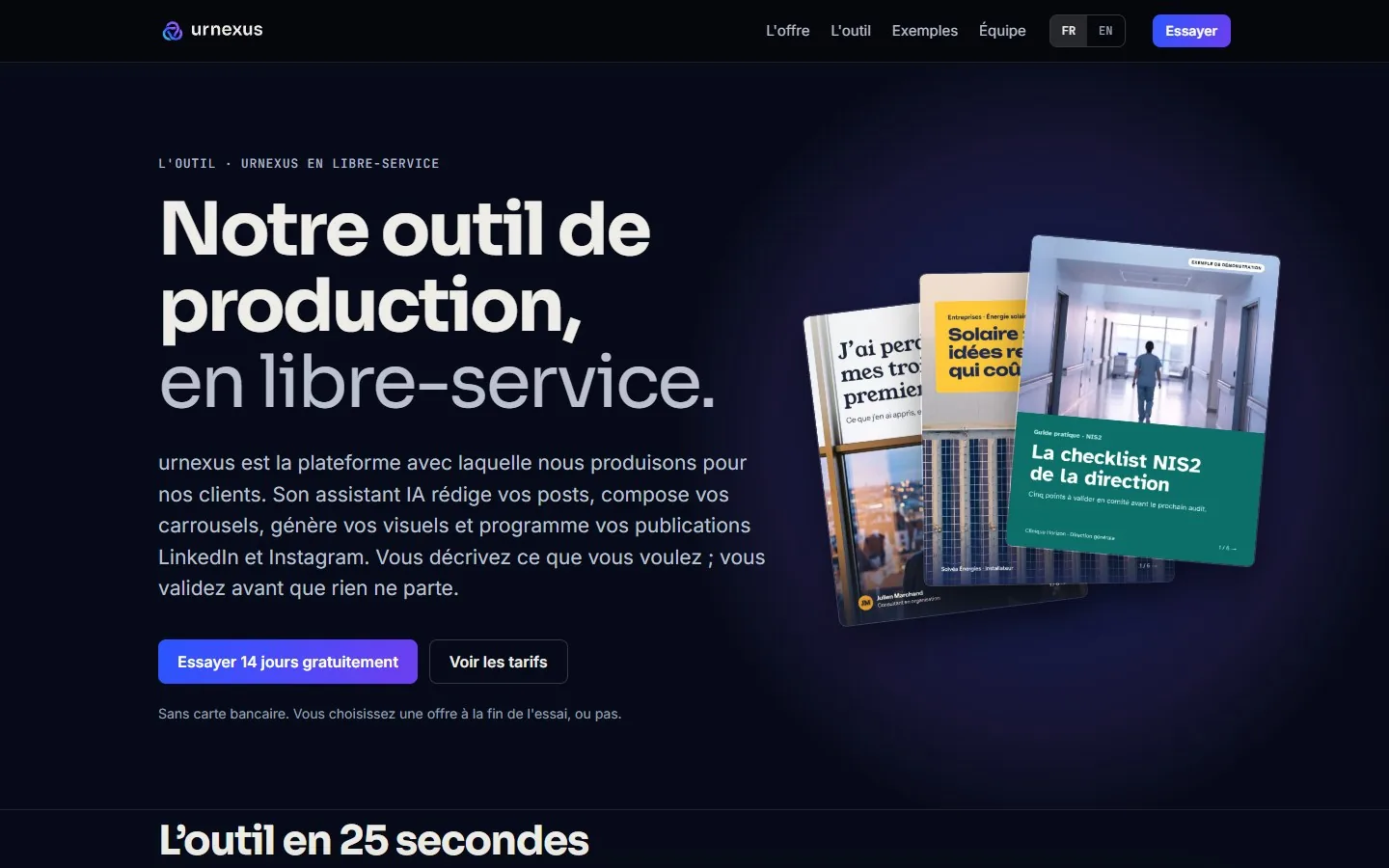
yournexus.fr is the marketing site for urnexus, a content and visibility service: one hour of interview a month becomes a month of LinkedIn posts, carousels, articles and a newsletter, approved by the client and built to be cited by Google as well as AI assistants. The page doesn't sell a feature list: it shows the monthly cycle, from the first interview to the report, and proves it with an example built from what the prospect has already published.

Visit yournexus.fr ↗Explore the tool ↗The showcase site and the tool page, live.
The target isn't a content creator short of ideas: it's an SME leader, in a regulated sector first (health, finance, law, energy, industry), who knows things his clients search for but never writes because writing takes time he doesn't have — and because a classic agency asks him to fill in briefs, then review text that doesn't sound like him.
The page states a second fact, less common for this kind of offer: clients now ask AI assistants their questions, not only a search engine. A leader absent from what an AI assistant knows about his sector loses the citation to someone else — visibility is no longer limited to a Google ranking.
The answer reverses a content agency's usual order: the leader fills in no brief and writes nothing, he talks for an hour a month to an interviewer, and it is that spoken word — not a prompt, not a brief — that becomes the month's raw material.
Rule stated on the site, for regulated sectors: content is not invented: it is taken from what the business owner says, then checked against a fact sheet about their company.
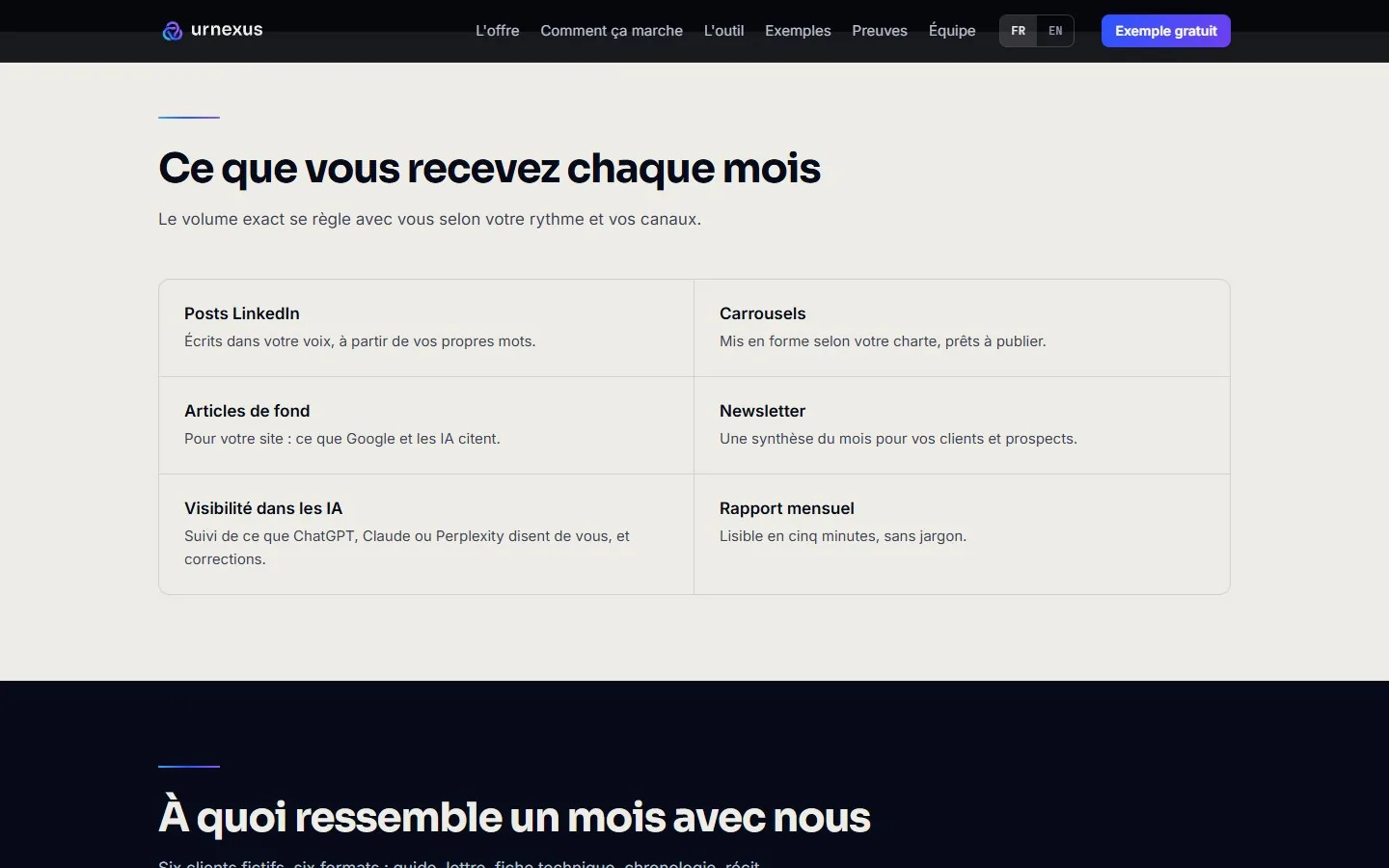
Rather than opening on a feature table, the page unfolds the six steps of a real month, in the order they happen. It is this sequence — not a grid of promises — that structures the rest of the page.
One hour on video, led by a professional interviewer. The conversation is about the client's real work: what he builds, his choices, what his own clients misunderstand.
The interview becomes a month of content: posts, carousels, articles, newsletter. Every figure cited is checked against the fact sheet approved by the client before it is shown to him.
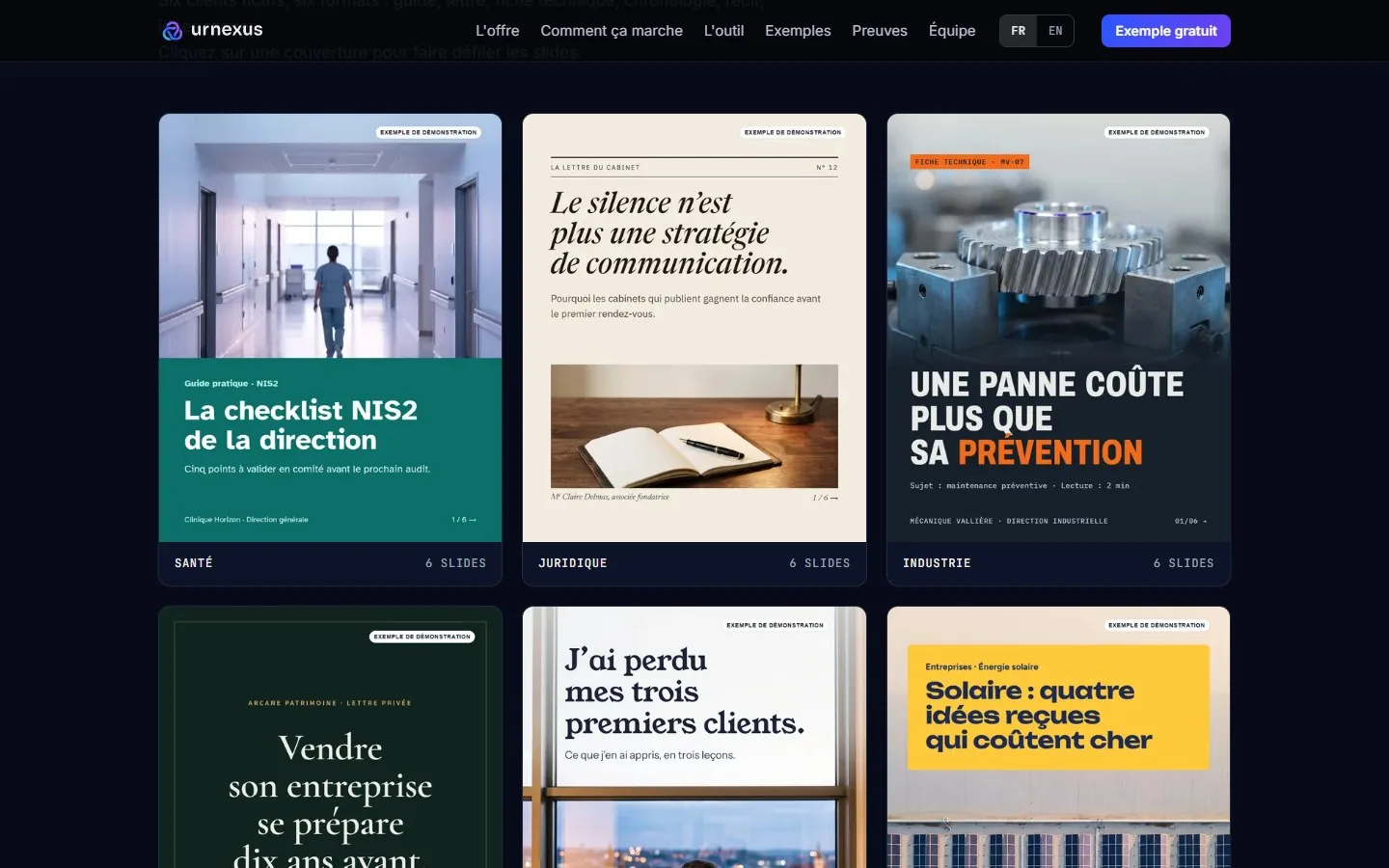
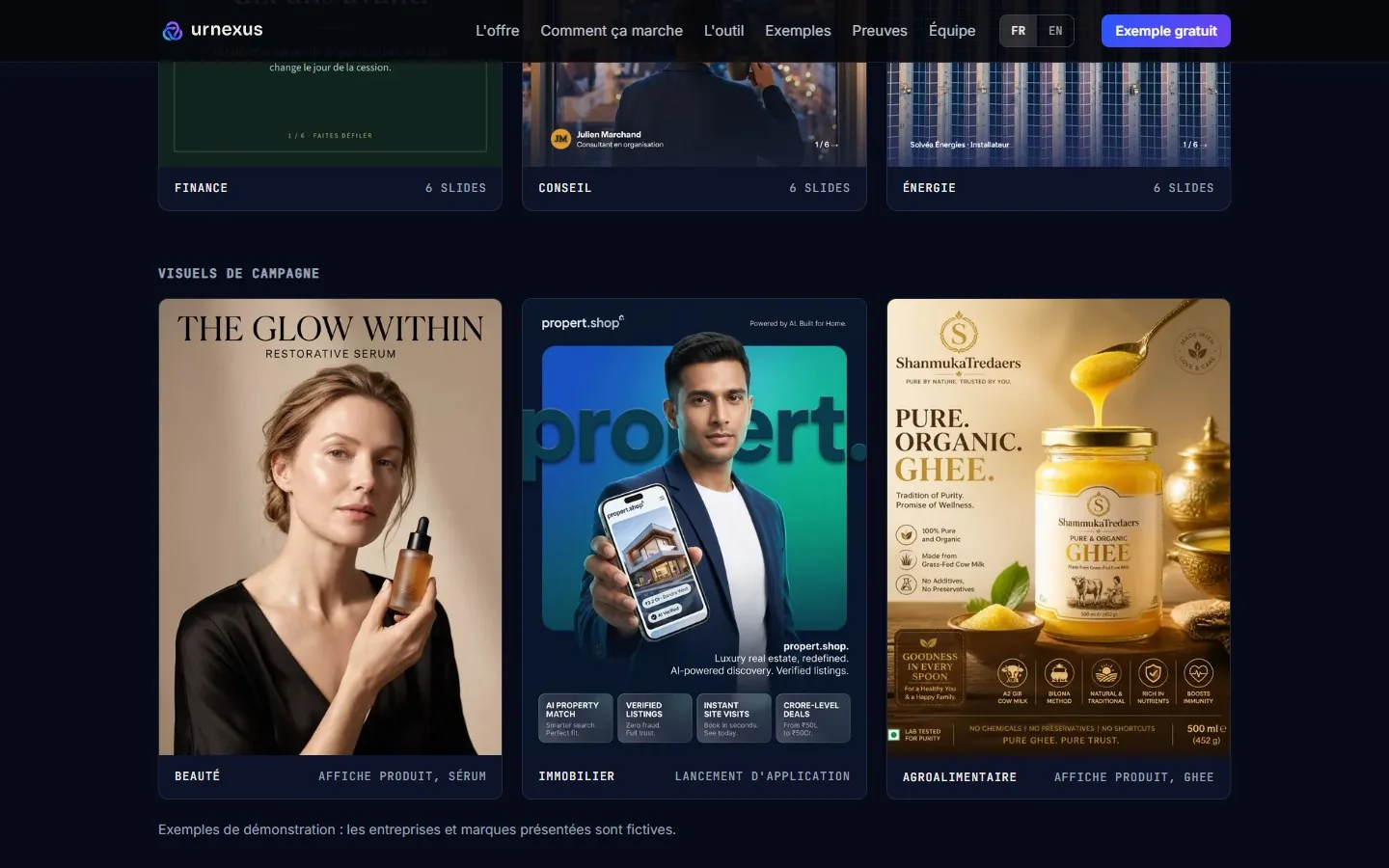
Visuals follow the client's brand guidelines and are reviewed by a senior product designer: no generic visuals.
The client reviews everything before it goes out. Nothing is published without his explicit approval.
Posts are scheduled, and the content is optimised for Google as well as AI assistants. What improves is tracked day after day.
A readable report: what was published, what was seen, where the client now appears, and what changes next month.


The page states this split explicitly rather than leaving it vague: AI agents do the production work, humans decide, check and answer. It is this split — not a "fully automated" promise — that serves as the argument on regulated sectors.
Leads the interviews and knows how to get a leader talking about what really matters, not what stays on the surface.
Senior product designer: designed the urnexus platform and the agents that produce the content, and signs off the visual quality of every output.
Transcription, writing, layout, fact-checking, visibility tracking. They work every day, under human control.
Guard-rail stated to prospects: no ranking guarantees, no fake reviews or fake community. The page explicitly chooses not to promise what it cannot keep.
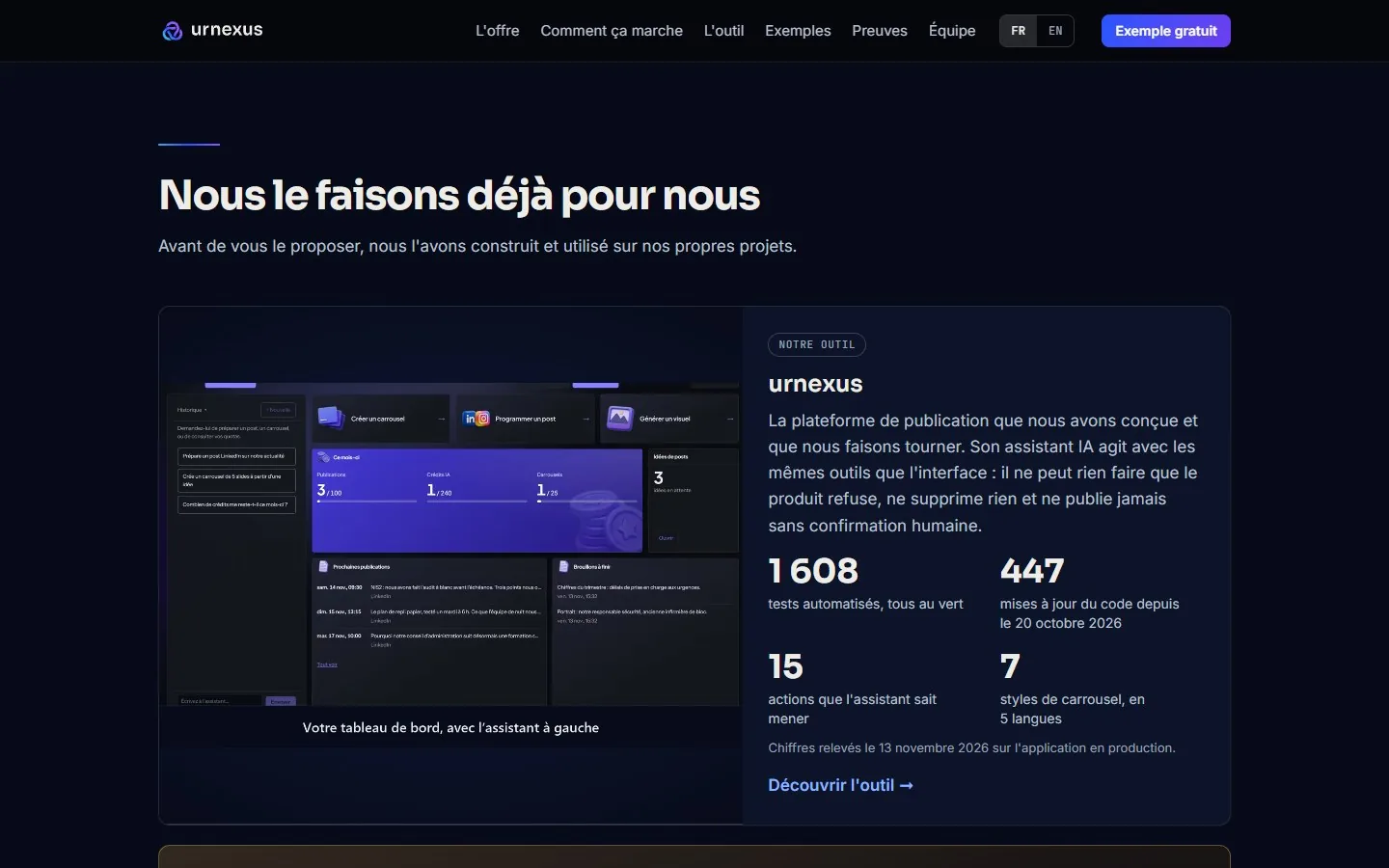
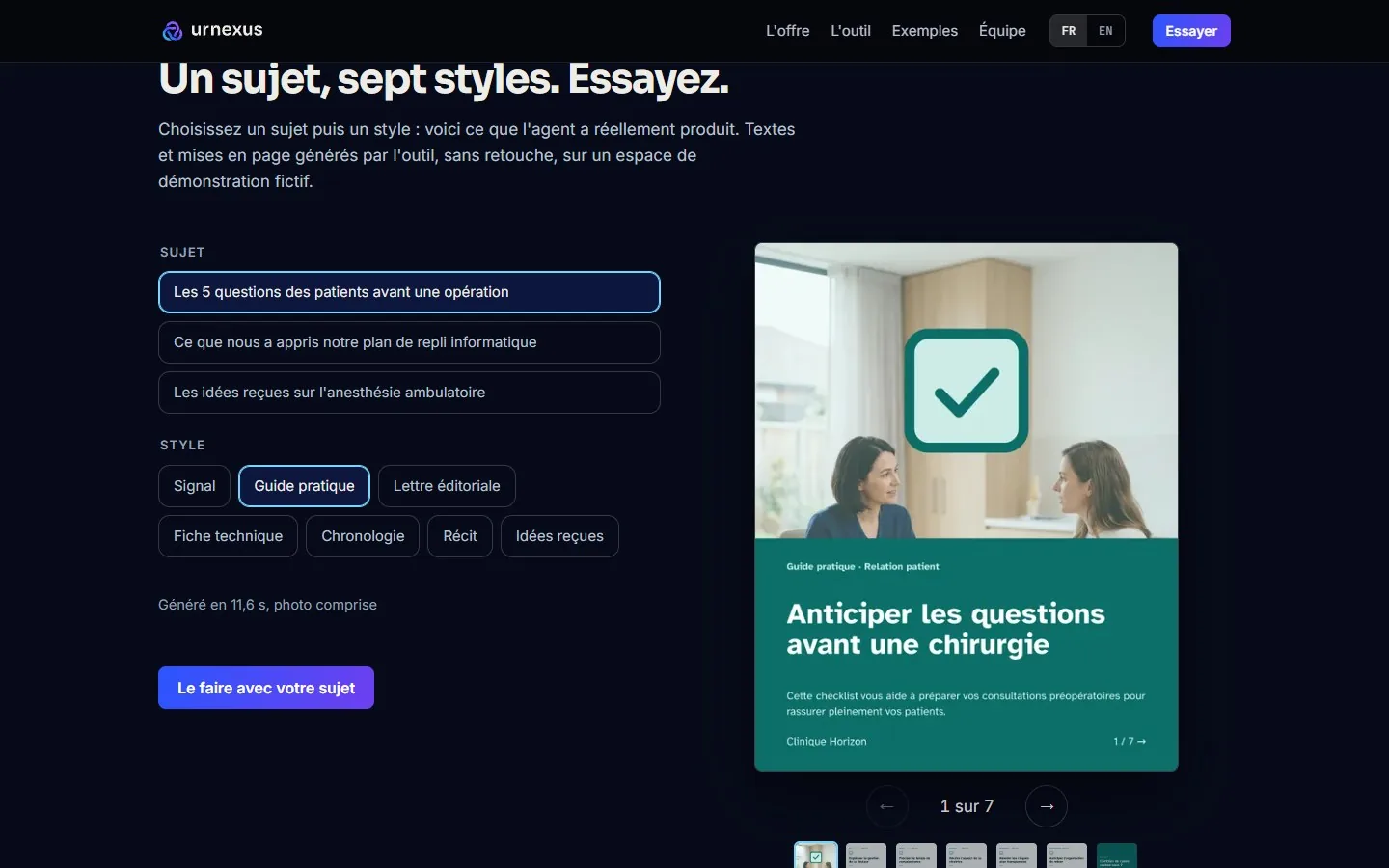
Rather than describing content quality, the page shows it twice: a free sample built from what the prospect has already published (which shifts the proof from "trust us" to "look what we did with your own words"), and a demonstration of the product turned on itself.

Counters as displayed on the site.
The marketing site links to a second page, dedicated to the self-serve urnexus tool: a leader who prefers to keep the hand opens his own workspace, connects his accounts, and works with the assistant at every step — without going through the guided monthly cycle.


The choice offered to the visitor: "Do it yourself, or hand it to us." Both paths share the same engine; only the hand holding the keyboard changes.
A site that sells visibility on Google and AI assistants must be beyond reproach on both fronts. Three structural choices, verifiable in the code served to the public:
llms.txt, not just a robots.txtBesides the usual robots.txt robots.txt, the site publishes an llms.txt at the root: a structured summary of the offer, how it works and the proof, written for an AI assistant to read directly rather than guess the content from the layout.
The robots.txt doesn't stop at the generic wildcard line: it names and allows the crawlers of the main AI assistants, alongside the usual search engines — a deliberate choice, not an oversight.
# AI search and answer engines: explicitly welcome User-agent: OAI-SearchBot Allow: / User-agent: ChatGPT-User Allow: / User-agent: ClaudeBot Allow: / User-agent: PerplexityBot Allow: / User-agent: Google-Extended Allow: / Sitemap: https://yournexus.fr/sitemap.xml
# urnexus > Content and visibility service for SME leaders, regulated > sectors first. One hour-long interview a month is turned into > LinkedIn posts, carousels, articles and a newsletter, approved > by the client, optimised for Google and AI assistants. ## How it works - Monthly one-hour interview, AI agents produce the content, every figure checked against a client-approved fact sheet. - Visual art direction by a senior product designer. - No ranking guarantees, no fake reviews or fake community. ## Proof - [case study link] ## The tool (self-serve) - [tool page link]: the software behind our content, self-serve.
Multilingual treated as a content surface, not a tick-box: every French page has its mirror /en/, and the sitemap.xml declares each version as the alternate of the other via xhtml:link hreflang, and the home page itself sets the hreflang="fr", hreflang="en" and hreflang="x-default"tags. An AI assistant reading the English version knows a French version exists, and vice versa.
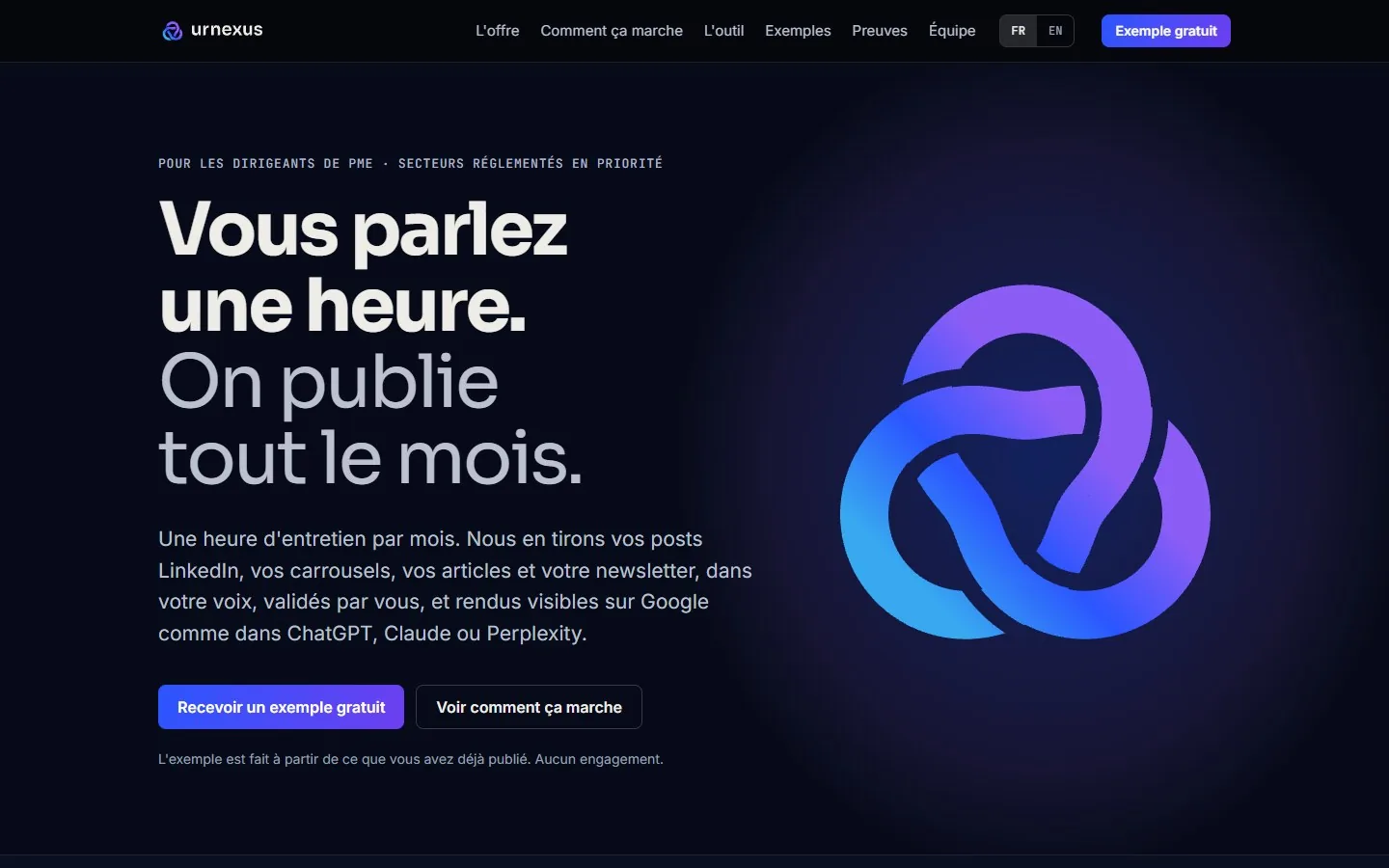
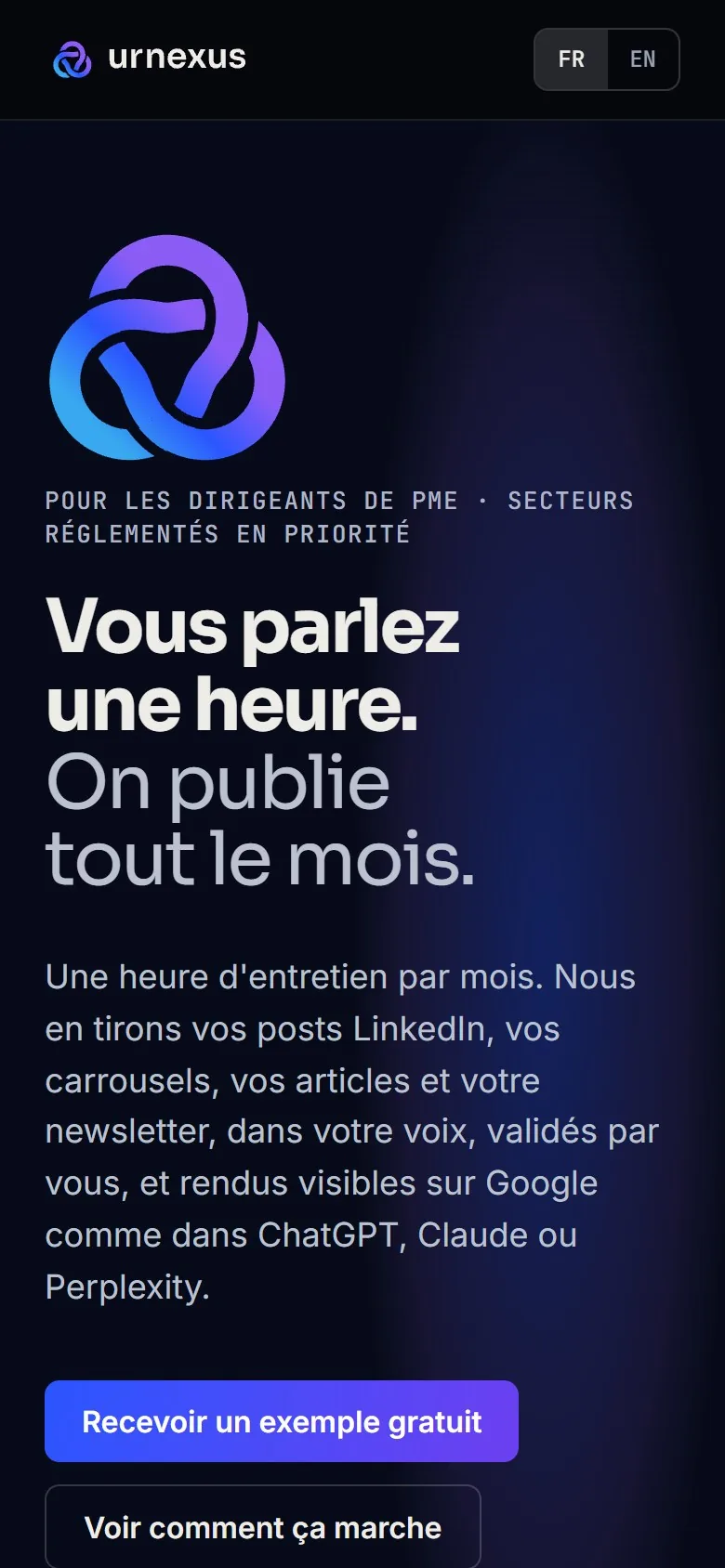
The site borrows the urnexus product's visual vocabulary (same type families, same colour register) but puts it to work for a service argument: long text sections, clickable examples, FAQ — closer to a sales page than a dashboard. Same structure checked on mobile, where the six-step cycle and the examples stay readable with no content cut.

Claiming content "sounds like you" convinces nobody: showing an example built from the prospect's own already-published words moves the proof from a promise to an observable fact. The winning page isn't the one that best describes the AI, it's the one that shows its result on the reader himself.
For an offer targeting regulated sectors, blurring the AI's share worries more than it reassures. Explicitly naming what the agent does and what the human checks — and refusing ranking guarantees — builds more trust than a vague speech about "artificial intelligence".
Writing that you optimise for AI assistants isn't enough: the robots.txt still has to explicitly allow them, and an llms.txt has to give them a structured summary to read. The site applies to its own search presence exactly what it sells to its clients.
robots.txt with AI crawlers explicitly welcomedllms.txt at the site roothreflang