Case study · podcast website · SEO & GEO

A podcast websitestatic, chaptered, read by AI as much as by humans

ODE is a long-form interview podcast run under NXStep. Its public website does not need a CMS: it needs chaptered episode pages, a correctly declared audio feed, a structured schema that search engines and AI agents can read without executing JavaScript, and a publishing process that cannot ship a silent regression.

Role
Design, build, technical SEO, operations
Context
Public podcast, distributed on the usual listening platforms
Stack
Static Python template · no CMS · no database
Identity
Bronze on black, low-poly Spartan helmet
21published pages1 single template
14journal articlessame skeleton, same schema
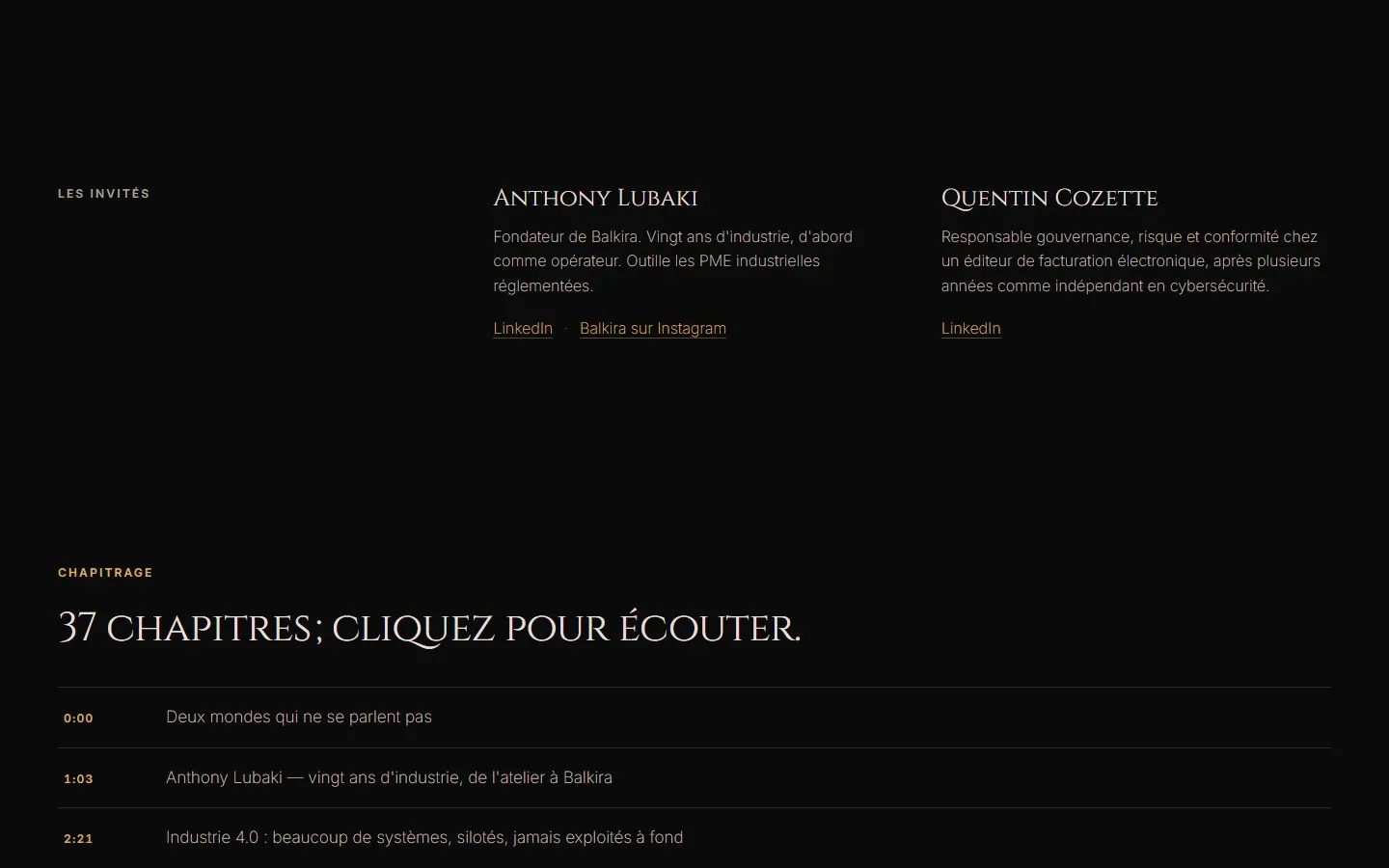
37clickable chapterson the pilot episode
0databasefully static site
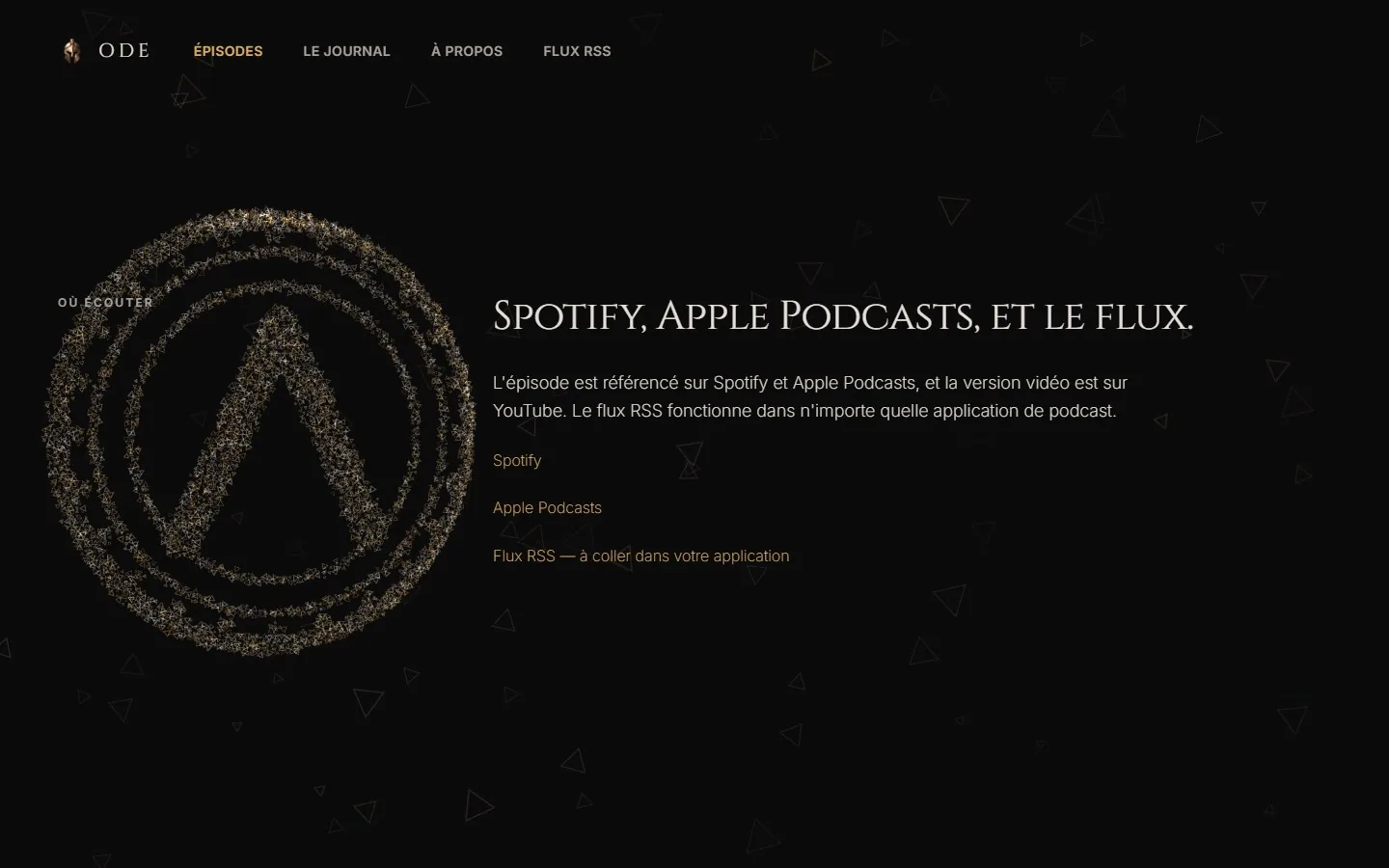
Home page of the site: the title Odyssée d'Entrepreneur, a tagline, a listen button, a Spartan helmet in golden particles on black.
The home page: a tagline, a listen button, the particle helmet.

Visit the ODE site ↗The live site.

The problem

A podcast website has two readers, not one

A human visitor skims an episode page, looks for the audio player, and leaves. A search crawler or an AI agent does not skim anything: it looks for fields. Building for the first reader and neglecting the second makes every episode invisible as soon as it leaves the social feed that made it known.

The content must exist without JavaScript

No AI indexing crawler, other than Googlebot, executes client-side script. A site that renders its main content in React in the browser is therefore, for these crawlers, a blank page — however much care went into the design.

An hour-long episode is not a single unit

A long interview cannot be cited as one block: a retrieval system needs to extract a precise passage, with its timestamp, its topic, and a link that points directly at the right second — not at the whole page.

The approach taken: a fully static, pre-rendered site where every page carries its own structured schema — not a layer bolted on afterwards, but the very source of the content.

The structural decision

A template, not a CMS

The site runs on no application server. A generator produces HTML pages from the same skeleton: an episode page, a journal article, an institutional page — each is an instance of the same template, never a file copied by hand.

Single template

One skeleton, variables

Title, chaptering, description, structured schema and breadcrumb are injected into the same HTML skeleton. Changing the structure of an episode page changes it everywhere at once, not one file out of fifteen.

Sitemap & robots

Computed, never edited

The sitemap and the robots file are recomputed from the pages actually present on disk, not maintained by hand. A page forgotten in the sitemap is structurally impossible: the script that produces it only knows what genuinely exists.

Checked copy

Minified on delivery, readable at the source

The repository's files stay readable and commented. Minification only applies to the copy prepared for publishing, never to the sources — so the reason behind a choice is never lost along the way.

What this actually changes. Publishing a new journal article or a new episode needs no change to the sitemap, to robots.txt, or to navigation: everything is recomputed from the real content when the deployment is prepared. Nothing can drift, because nothing is maintained twice.

Search ranking and readability by AI

A different structured schema per page type

Classic search ranking (Google) and generative ranking (what an AI cites in its answer) share the same technical base: accurate structured data, self-contained content units, and full access for retrieval crawlers.

Page typeStructured schemaWhat it carries
PodcastSerieshomepagethe RSS feed, the language, the series' identity for podcast apps and search engines.
PodcastEpisodeepisode pageduration, guests, and above all a list of Clip — one per chapter, each with its timestamp and its direct link.
BlogPostingjournal articlethe article linked to the source episode via isBasedOn, so that citing an article leads back to the interview it is drawn from.
BreadcrumbListevery pagethe page's position in the site, independent of the visible menu.

On the pilot episode, the chaptering produces 37 entries in the schema: each one has a title, a start second, and a URL that points directly at that passage. It is the most extractable format there is for an hour-long interview: a retrieval system no longer has to guess where an idea starts, the template tells it.

// Extrait anonymisé, allégé — valeurs réelles remplacées par des repères
{
  "@context": "https://schema.org",
  "@type": "PodcastEpisode",
  "name": "01 — titre de l'épisode",
  "episodeNumber": 1,
  "seasonNumber": 1,
  "duration": "PT60M5S",
  "inLanguage": "fr",
  "partOfSeries": {
    "@type": "PodcastSeries",
    "name": "nom de la série",
    "webFeed": "https://flux-rss.exemple/série.rss"
  },
  "author": { "@type": "Person", "name": "l'hôte" },
  "actor": [
    { "@type": "Person", "name": "un invité", "jobTitle": "fonction de l'invité" }
  ],
  "hasPart": [
    { "@type": "Clip", "name": "titre du chapitre", "startOffset": 0,
      "url": "https://exemple/episode.html#t0" }
  ]
}

Blocks that read on their own

Journal articles follow a writing rule: self-contained sections of 120 to 180 words under each subheading, with no "as seen above" cross-reference. It is the block size a retrieval system extracts and cites — a block that depends on its neighbour loses its meaning out of context.

Two layers, never mixed

Every article separates the guest's quoted words from the editorial contribution, visually and structurally distinct. A figure without a named source in the body text is not published.

Crawler access

Open to retrieval crawlers, named one by one

Allowing a generic crawler (User-agent: *) is not enough: a model vendor often runs several distinct crawlers — one for indexing, another for on-demand reading triggered by a user. The site's robots file names them individually, rather than relying on a general rule that could be restricted later without it showing.

OAI-SearchBotChatGPT-UserClaude-SearchBotClaude-UserPerplexityBotPerplexity-UserGooglebotBingbotGPTBot

A deliberate choice. Training crawlers are also allowed — the common reflex is to block them, but the podcast's primary purpose is to make its guests known: appearing in a model's weights serves that goal rather than threatening it. The sitemap is submitted directly to the engines that allow it without an account, to shorten the delay before first indexing.


Identity applied to the web

Bronze on black, a single pictogram

The visual identity precedes the site: a Spartan helmet rendered in low-poly facets, its face formed by negative space rather than drawn. Discipline and resilience rather than the usual startup-podcast imagery — and a palette narrowed to four shades, so the bronze accent stays rare, and therefore noticed.

Low-poly Spartan helmet in metallic bronze on a black background, face formed by a negative-space cutout — the podcast's identity pictogram.

The pictogram is the only figurative element in the whole identity: no face photo on the public site, no guest or host portrait on the cover. The weight of representing the brand rests on an object, not on people.

Matte black — #111111, dominant background Dark bronze — #A67C52, accents Light bronze — #DABF97, secondary text Gold — #DAAE67, main logo

What this imposes on the code. A four-shade palette on a near-black background tolerates no stray accent: no alert red, no default link blue. The site's few colour accents — links, badges, active borders — strictly reuse the same four values as the pictogram.

The publishing safeguards

A static site can still break silently

Without a database or an application server, the classic regressions disappear — but a new one appears: nothing technically prevents publishing an older version of the content than the one already live. The site guards against this specific case, not only against outages.

  1. The copy to production is never destructive

    The deployment copies the new files without ever first erasing the served directory. Stale content was once republished by mistake, overwriting a more recent version: since then, publishing stays a deliberate act, never an automation that could run again from a stale base without anyone noticing.

  2. A check after every deployment, not before

    A script queries the live site once the copy is done: every expected page must answer 200, and every internal file — working notes, generation scripts — must answer 404. The exit code signals failure; nothing is declared "live" on the strength of the copy alone.

  3. The sitemap also serves as a test

    The same check re-reads the published sitemap and verifies that every URL it lists actually answers 200. A sitemap announcing a missing page is an error caught automatically, not left for a search engine to discover.

  4. Orphan files are flagged, not blindly deleted

    Before cleaning a served directory, the deployment compares what it produces against what is already live and lists the differences. A file dropped in by hand for a one-off need — an image, an export — can be explicitly exempted from that list, so cleanup never destroys again what was deliberately added outside the repository.

Audience measurement without a cookie

The measurement tool is self-hosted and served from the same domain name as the site, under a discreet path: no request goes out to a visible third party, and common ad blockers that rely on domain names do not intercept it. No cookie is set.

A page to keep the team's own figures honest

A dedicated page lets the team set, per browser and per device, a simple local marker that excludes its own browsing from the measurement. It is not an opt-out offered to the podcast's visitors: it is an internal tool, so that proofreading and verification back-and-forths do not inflate the real audience figures.

Takeaways

What this project taught me

An up-to-date sitemap is a computed sitemap, not an edited one

Keeping a sitemap by hand guarantees it will eventually lie — a page added without thinking about it, a page removed but forgotten in the file. Having it recomputed from the pages actually present on disk makes the error structurally impossible, not merely less likely.

Ranking for AI is not an act, it is a structure

Submitting a sitemap once is not enough. What makes content citable is the shape of the content itself — self-contained blocks, a schema that breaks an hour-long interview into units timestamped to the second — built once into the template, and therefore valid for every future page at no extra effort.

The safety of a deployment is proven afterwards, not beforehand

Checking the copy before publishing it detects none of what matters: it is the actually served site, with its cache and its configuration, that must be queried. A check that hits the live site after every deployment catches regressions that no file review would have seen.

Delivered

  • Static site generated from a single template, no CMS, no database
  • Structured schema per page type (series, chaptered episode, journal article)
  • Sitemap and robots.txt recomputed on every publication from the real pages
  • Automated post-deployment check (expected pages, private files excluded, sitemap consistency)
  • Cookie-free audience measurement, same origin
  • Bronze-on-black identity applied to the code (four-shade palette)

The site receives an episode already finished: see how it is produced.